Developing a digital workplace in facility management
A digital workplace in 3 steps

Frank Braun
Managing Partner RealCore Group
Digital workplace in facility management
The following article is a summary of the post published on the d.velop blog in December 2024, CAFM – A digital workplace in 3 steps. In three steps, we show how to successfully manage the transition to a digital workplace in facility management.
A digital workplace in facility management connects systems and applications on a central platform, bringing transparency and efficiency to the administration and control of buildings, facilities and resources. Computer Aided Facility Management (CAFM) plays a key role here. It is a computer-aided system that supports the administration, optimisation and control of buildings, facilities and resources.
Challenges of digitalisation in facility management
.
The switch to digital solutions comes with challenges. Many companies still work with isolated standalone solutions that are neither integrated into the system landscape nor future-proof. These isolated solutions create data silos, hamper processes and increase complexity. Flexible CAFM software that adapts to existing IT landscapes and takes future requirements into account is therefore essential.
Another aspect is the efficient organisation and use of data. In many cases, data is unstructured, redundant or difficult to access, which makes digitalisation harder. Companies therefore need not only to introduce software solutions but also to rethink their internal structures and processes
A digital workplace in 3 steps
Step 1: Get an overview
Business processes are the heart of a company, as they control all activities and resources. A successful digitalisation strategy should therefore focus firmly on value-adding business processes.
To select suitable CAFM software, it is essential to make your business processes as transparent as possible. Only precise documentation and a clear overview of existing processes allow you to identify weaknesses and uncover potential for improvement. It makes particular sense to start with processes that offer high potential for value creation and cost savings. For each process, you should analyse where data is created and what requirements apply to its audit-proof archiving.
Step 2: Make optimal use of your existing IT infrastructure
A digital workplace in facility management can benefit considerably from the smart use of existing IT infrastructure. Solutions from Microsoft (M365, Teams, SharePoint, Power Platform), SAP or ServiceNow already offer many useful tools that can be integrated and linked extremely well.
In practice, most companies already use Microsoft products. Below, we summarise Microsoft's toolbox:
- Microsoft SharePoint is the ideal platform for bringing people together. Documents generated in day-to-day work are managed securely. Structured data storage with metadata (e.g. master data from an ERP system) simplifies collaborative work.
- Microsoft Teams enables collaboration on files and projects across company boundaries.
- Within the Power Platform, you can both implement automated process workflows quickly and easily and create your own no-code/low-code apps.
Step 3: Setting up the digital workplace with CAFM
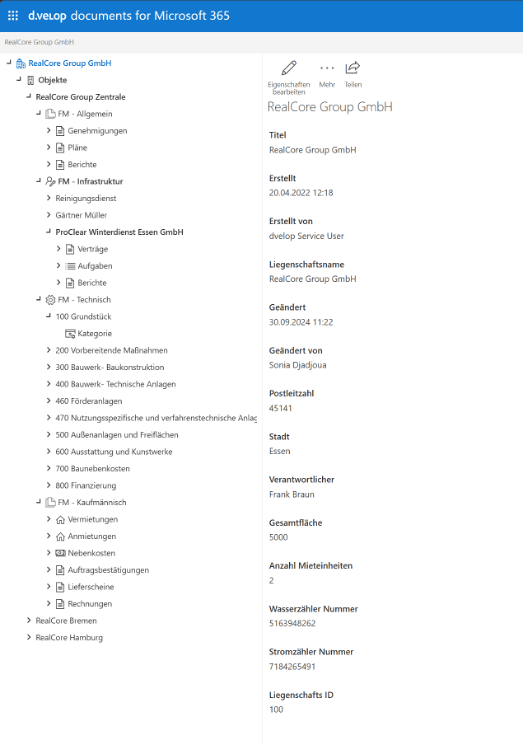
However, a modern digital workplace requires more than just simple data storage. Together with our partner d.velop, we have developed a CAFM solution for real estate and facility management based on Microsoft SharePoint, Teams and d.velop documents for Microsoft 365. Contracts, documents and other correspondence are brought together centrally in files. Microsoft Teams serves as the user interface and provides access to the files.
The file structure shown illustrates how facility management might be organised within a company. By default, it is divided into the four categories relevant to FM, but it can also be customised:
- FM - General: Covers administrative aspects such as permits, plans and reports.
- FM - Infrastructure: Includes operational services such as cleaning or grounds maintenance, as well as the management of contracts, tasks and reports.
- FM - Technical: Structures technical matters into categories such as building construction, technical systems, conveyor systems and outdoor facilities.
- FM - Commercial: Focuses on financial and contractual management, for example lettings, rentals and invoices.
- This clear structure makes it easier to keep track of and assign the various FM activities, and enables efficient management of properties and services.
Outlook for CAFM
The digital transformation of facility management has long ceased to be an option; it is a must for companies that want to remain competitive. As CAFM systems continue to evolve, it will soon be possible to automate even more processes and achieve further efficiency gains through AI-supported functions such as predictive maintenance or optimised use of resources.